India
6 months based in Mumbai with trips around India, discovering the untold story of the nation’s passion for the game.
↓
Introduction
“Do Indians play or even watch football…?”
Indian football fans have a huge interest in the top European leagues. What’s it like to watch El Clasico or the Manchester Derby in Mumbai?
What does a local game look and feel like, and what are the routines and rituals?
The national teams are now both at all time high. When will India make their first World Cup?
In a nation world renowned for its cricket, why did football never quite catch on in the same way?
These questions spurred me on to dig a little deeper into the world of Indian football. During the 6 months I was lucky enough to meet people from across the spectrum of the game in India, uncovering a fascinating range of stories.
Highlights
A collection of articles, videos and photos from my time exploring football culture in Mumbai, Goa, Kerala and Kolkata.
To see the full Indian story (so far), check out the links below, the blogs at the bottom, or scroll through my Instagram feed.
Blog
A collection of stories and experiences from my time in India, featuring personal blogs as well as articles featured on BBC Sport.
High-profile club ownership is nothing new to the football world. But what about when your owner happens to be a movie star with about 18 million social media followers, who started the club from scratch and is involved in its day-to-day affairs? Meet John Abraham, the Bollywood star who dreamed of playing for his country as a young boy, and who is now investing far more than just his money to build a football legacy in his home country.
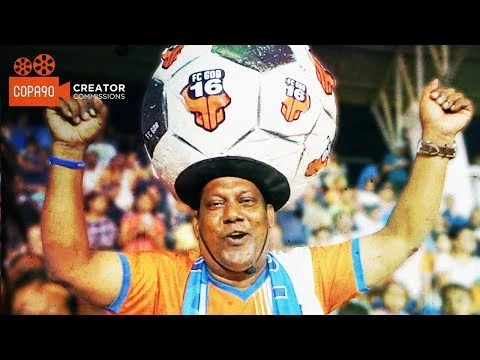
My first impressions of Indian football culture were all experienced through the city of Mumbai. Despite the growing interest and clear passion for the game there, so often it is overtaken or forgotten, whether thanks to cricket, or any number of other economic, geographic or social factors. When I enquired about football throughout the rest of India, three key states were mentioned: Kerala, Bengal and Goa. Friends described to me scenes of colour and chaos on game days, packed out stadiums and thriving grassroots cultures, and it seemed a necessity to go and witness some of this for myself.
In the cramped and colourful streets of Colaba's Ambedkar Nagar, a slum community in the south of India's biggest city, the Women's World Cup seems a long way away. Meet Mamta Prajapati, a 15-year-old defender, and Atisha Saini, an 18-year-old attacker, two young women who are defying tradition to follow their football dreams.
Most people would assume an Indian sporting fixture that regularly attracts more than 100,000 people could only be one thing: a game of cricket. But tell that to the people of Kolkata, who on Sunday gathered at the city's Salt Lake Stadium for the latest instalment of the 'Boro Derby', as East Bengal took on Mohun Bagan in what might well be the most well-attended, fiercely competitive and historically significant derby you've never heard of.
Although this trip was intended to be more about relaxation than football discovery, upon opening the boot of the car I was greeted with a bag brimming full of balls and plastic cones. Remembering my friend’s forewarning that his Dad had been ‘a bit of a player’ back in the day, and was still involved in the local football scene here in Goa, I was curious to find out more about his story.
He introduced himself as Mario, and after a few minutes of speaking, it transpired that he was a freelance footballer based here in Mumbai. I was intrigued to find out more, and Mario kindly invited me to join him and a friend the following day for practice at a nearby ground. Curious to discover more about the origins of Mario’s freestyle career, and to learn about where this form of the game fits into Indian football culture, the next day I was up and at it, en route to Vile Parle to find out more.

BBC Sport